Bangkok, Thailand, October 2026.
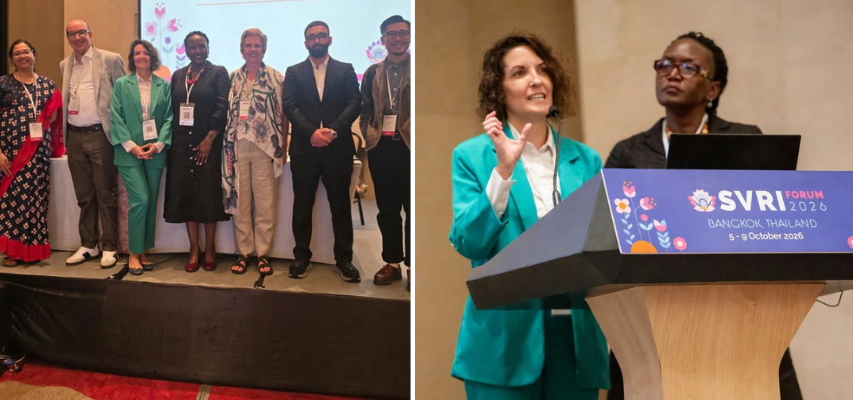
Uganda had the opportunity to share its experience of delivering justice for survivors of sexual and gender-based violence (SGBV) with a global audience at the recently concluded Sexual Violence Research Initiative (SVRI) Forum 2026, held in Bangkok, Thailand, from 5 to 9 October.
The JLOS Secretariat was represented by Ms Lucy Ladira, Technical Advisor for Criminal Justice at the JLOS Secretariat, and Ms Laura Lafuente Criado of UNFPA Uganda. The presentation focused on how Uganda is leveraging the synergies between its formal courts and customary justice structures to address the needs of survivors of sexual and gender-based crimes.
The SVRI Forum is the world’s largest abstract-driven feminist convening on ending violence against women and children. Co-hosted by SVRI and the Prevention Collective and supported by the Australian Department of Foreign Affairs and Trade, this year’s edition drew more than 1,500 delegates from over 80 countries and featured more than 650 presentations under the overall theme, “Where research, collaboration and innovation converge”. This year’s Forum specifically centred on seven key areas: understanding root factors, strengthening prevention and response services, examining the role of technology, enhancing research and practice, driving policy change through evidence, and building a sustainable, mentally healthy evidence ecosystem.
Bridging two systems of justice
Uganda’s presentation, “Survivor-Centred Justice in Uganda: Bridging Formal Courts and Customary Justice Through Coordination, Referral Pathways and Law Enforcement”, tackled a question many countries still struggle with how to connect state courts with the community and customary mechanisms that many survivors go to as a first point of contact for redress. Uganda’s pluralist system, in which statutory courts, Local Council (LC) courts, cultural institutions and community leaders all play a part, offers a distinctive case.
The presentation was candid about the difficulties. Many rape and defilement cases take two years or more to conclude, conviction rates remain low outside the special sessions project, and survivors still face barriers in terms of evidence, access to services and awareness of their rights. In response, the justice sector has established an SGBV desk at Uganda Police Force Headquarters, as well as special sessions and procedures within the Office of the Director of Public Prosecutions and the Judiciary.
Uganda presented Customary mechanisms as both an asset and a risk. They are close to communities and widely trusted, but without oversight they can discourage disclosure or push survivors towards reconciliation. Uganda’s draft Second National Action Plan on the Elimination of Gender-Based Violence (NAP II), now being finalised by the Ministry of Gender, Labour and Social Development, provides for strengthening these institutions on the condition that they act in the survivor’s best interest.
The central message was that the choice between formal and informal justice is a false one. Survivors move between both systems, often at the same time, and need a coordinated referral pathway linking community structures, the police, health and psychosocial services and the courts. Its essentials include clear documentation, survivor consent at every stage, confidentiality and feedback between community and formal actors.
Delegates from Kenya, Rwanda, Botswana, Bangladesh, Indonesia, South Africa, Australia and several European donor countries attended the session. Several noted that the draft NAP II goes further than many national plans by making the survivor’s best interest a condition of policy. Others asked how LC courts and cultural institutions will meet that standard without formal oversight, a gap the presentation acknowledged. Humanitarian practitioners showed interest in adapting the referral approach to displacement settings.
“Our measure of justice is that justice must be experienced by the people – not merely administered,” said Ms Lucy Ladira.
The Forum also examined technology-facilitated violence, and the research shared in the meetings was useful in informing initiatives by the justice sector in view of the legal lacuna regarding the law on non-consensual intimate imagery despite the Computer Misuse (Amendment) Act 2022; the link between climate stress and SGBV, which echoes experience in Karamoja and refugee-hosting districts; and evidence on cash transfers and humanitarian response which is of direct interest to a country hosting one of Africa’s largest refugee populations.
The session opened avenues for collaboration with the SVRI research team, the London School of Hygiene and Tropical Medicine, the UNFPA Asia-Pacific Regional Office, the African Union Commission and UN Women East Africa. The mission recommends that the JLOS Secretariat and UNFPA Uganda jointly develop an operational referral pathway protocol, train LC court members and cultural leaders on survivor-centred standards and build survivor feedback into NAP II coordination.