Mbarara, 13 October 2026
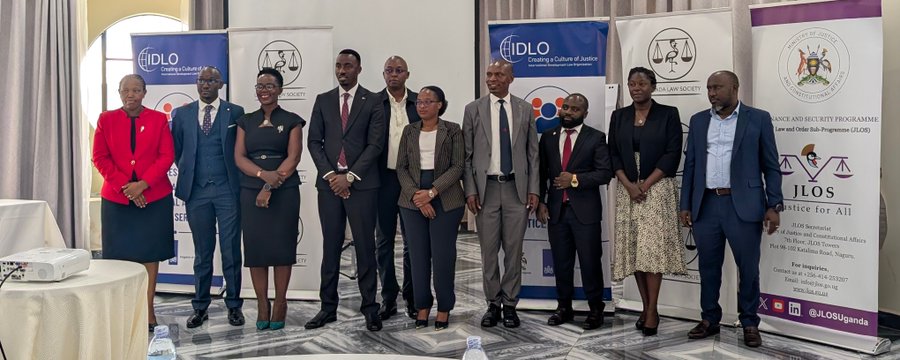
Legal practitioners from the western region gathered in Mbarara today for a training on Land and Commercial Justice, organised by the Uganda Law Society (ULS) in partnership with the International Development Law Organisation (IDLO), the Governance and Security (JLOS) Secretariat and the Embassy of the Kingdom of the Netherlands in Uganda. Offered free of charge to participants, the training brought together advocates, academics and public officials to share practical experience on some of the most common and contested land matters in Ugandan legal practice.
The Mbarara session is part of a regional series. Three more trainings on the same theme will be held in Arua, Gulu and Kampala, extending the programme to practitioners across the country.
Land at the heart of legal practice
Opening the training at Las Vegas Hotel in Mbarara, the Vice President of the Uganda Law Society, Mr Asiimwe Anthony, described land justice as the bedrock of justice in Uganda. He observed that land matters account for about 80 per cent of legal practice in the country and touch almost every area of work, including the drafting of wills.“Legal practice in Uganda is very dynamic and diverse in each region,” he said. “The cultural influence in land matters is not taught in law school. The way things are done in Busoga is different from Mbarara. It is important to keep appreciating experience sharing, as it will improve our practice.” He thanked JLOS, IDLO and the Netherlands Embassy for their continued commitment to strengthening access to justice.
Speaking on behalf of the JLOS Secretariat, Ms Grace Angeline Chelimo noted that land and commercial justice are closely linked, since land is the main form of collateral used to secure loans and commercial credit. “Delays in the resolution of land and commercial disputes negatively affect agricultural productivity and livelihoods, and suppress private investment, which in turn hinders economic development,” she said. She encouraged participants to use the training to acquire skills they can apply directly in handling transactions, drafting legal documents and litigating cases.
Drafting in the age of artificial intelligenceMr Collins Nuwamanya, Advocate at Kesiime & Co. Advocates, led a session on mastering commercial agreement drafting in the age of artificial intelligence. Addressing whether AI can replace lawyers, he urged practitioners to work in a more technology-savvy way. He explained that AI can increase speed and output, summarise long texts, and act as “a second mind” against which a lawyer can test a draft. “While AI can draft, the lawyer should be able to refine and guide the AI, and not the other way round,” he said.
Due diligence and safeguards in land transactions
Ms Godlive Nayebare, Advocate at Rukabura-Ruhome Advocates, spoke on key considerations and legal safeguards in land transactions and the drafting of pleadings. She reminded participants that due diligence goes well beyond a visual inspection. It requires survey reports from professional surveyors, a land registry search to confirm ownership and check for encumbrances, and a physical visit to the land to verify who truly owns it. She added that lawyers must operate escrow accounts to separate client funds from the firm’s, handle tax filings, and ensure stamp duty is paid.
Mr Franco Barekensi, Lecturer at the Law Development Centre, presented on the role of lawyers in protecting clients’ interests in mortgage agreements. “If you are representing the client, put the client’s interest first. Protect the client, not the bank,” he said. He advised practitioners to go to the village to establish the land’s true status, warning that a single plot may be mortgaged to a SACCO, a moneylender, and a bank at the same time, and that local council chairpersons can be easily influenced. He also cautioned that clients may withhold the truth when it threatens a transaction, and that many borrowers do not read mortgage documents because they urgently need the money. “Do the work. Do not get caught up in a transaction that could land you in trouble with the law,” he said.
The case for alternative dispute resolution
Mr Allan Musasirwe, Partner at Katembeko & Co. Advocates, made a strong case for alternative dispute resolution (ADR) in land and commercial disputes. Drawing on his own caseload, he noted that some matters he is handling were filed before he was born, and that a long stay in court does not translate into more income for a law firm. He added that even a hard-won judgment may be reviewed by another court at the enforcement and execution stage.
“The reality is that we have lost trust in this adversarial system. That is why ADR is a better solution,” he said. He pointed out that mediation has significantly shortened the time cases spend in court, citing figures for FY2024/25, when 6,803 of the 10,401 cases handled through mediation, about 65 per cent, were resolved. “The law should be a tool to develop communities and build trust. ADR is legal, and it is a more effective way of delivering justice in our communities.”
Digital services at URSB
Mr Nicholas Mwebaze of the Uganda Registration Services Bureau (URSB) updated participants on recent developments and encouraged them to move from physical submissions to the online portal. The Online Business Registration System (OBRS) has been merged into the e-registry, through which participants can now access all URSB services. These include SIMPO, which registers securities for moneylenders, and intellectual property registration.
He explained that Form 18 and Form 20 have been combined, so only three forms are now required to register a company, and fees can be paid by mobile phone. URSB has also introduced a new register that consolidates individual information in one place. Registration is free and requires only an email address, valid identification and a phone number. Upon completion, each registrant receives an Entity Registration Number (ERN) for all interactions with the system, covering business names, companies and associations, and giving banks and other institutions access to accurate data.
Looking ahead
The Mbarara training gave practitioners a valuable platform to share regional experience and update their skills in an area that shapes livelihoods, investment and public confidence in the justice system. The Uganda Law Society confirmed it will carry the conversation forward in Arua, Gulu, and Kampala in the coming weeks.