
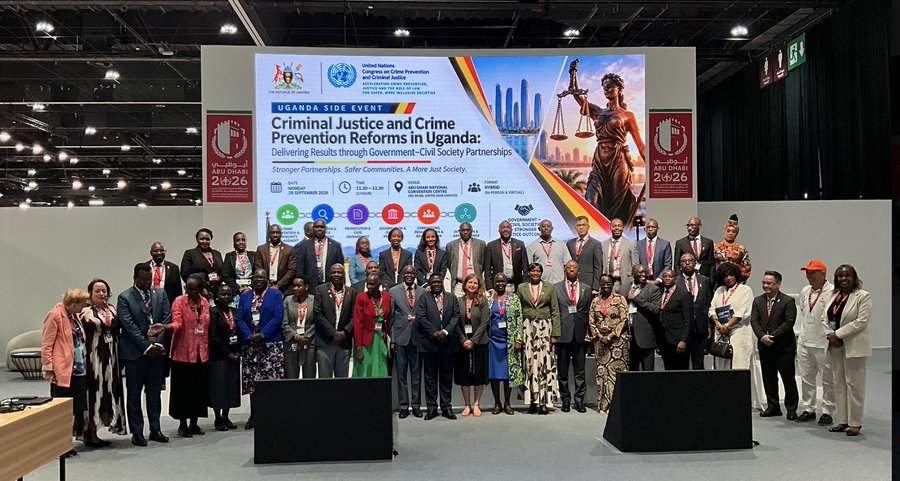
Justice in Uganda reaches people through partnership, and today the country’s justice leaders showed the world how that works. At its side event at the 15th United Nations Congress on Crime Prevention and Criminal Justice, Uganda highlighted that the Government and civil society should plan crime prevention, access to justice and rehabilitation together from the start, rather than calling on each other once a problem has already arrived.
The session, titled “Criminal Justice and Crime Prevention Reforms in Uganda: Delivering Results Through Government and Civil Society Partnerships”, was co-organised with the Legal Aid Service Providers Network (LASPNET) and Uganda Youth Development Link (UYDEL). The Minister of Justice and Constitutional Affairs, Hon. Norbert Mao, the Principal Judge, Hon, Jane Frances Abodo and the Director of Public Prosecutions, Mr. Lino Anguzu, shared the stage with civil society leaders, with Uganda’s Deputy Head of Mission at the Uganda Embassy in the United Arab Emirates (UAE), H.E Aisa Ismail, in attendance and an audience following online.
From punishment to restoration
Opening the session, the head of Uganda’s delegation, Hon. Norbert Mao, described a justice system in the middle of a deliberate shift from retribution to restoration. He pointed to steady progress in reducing the number of people held on remand, mobile courts that bring justice to children in conflict with the law, and the wider use of non-custodial sentences. “We believe that the criminal justice system should not just be about punishment. We believe that many of our citizens can be reintegrated into society as law-abiding citizens,” he said.
Ms Rachel Odoi-Musoke, Senior Technical Advisor at the Governance and Security Programme (JLOS) Secretariat, explained the Chain-Linked Initiative, under which Government institutions and civil society organisations tackle criminal justice problems as connected parts of one system. Experience, she said, had taught Uganda that “crime prevention starts with communities”, and that civil society’s role in rehabilitation and victim support must be properly recognised. “We need to move to a partnership by design between Government and society,” she said.
From projects to institutions
The Principal Judge, Hon. Lady Justice Jane Frances Abodo, said the relationship between the State and civil society in Uganda has matured. “Civil society is a partner, and as Uganda we have moved from projects to sustainable partnerships,” she said. Such partnerships must strengthen judicial independence and include clear roles, accountability, and measurable outcomes. Crime prevention, in her view, works alongside prosecution and rehabilitation rather than apart from them: “Prevention is intelligent justice.”
The Director of Public Prosecutions, Mr Lino Anguzu, took the argument a step further, calling for partnerships to move from project funding cycles into institutional mechanisms with clear rules, referral arrangements and accountability. “Effective prosecution relies on partnerships, including quality investigation, quality prosecution and civil society’s work in crime prevention and rehabilitation,” he said.
Reaching young people before crime does
Dr Rogers Kasirye of @UYDEL described school-based prevention work that has now reached 120 schools, producing youth clubs and a growing corps of peace ambassadors. “We are using school clubs to encourage young people to live their lives away from crime through positive alternatives such as drama, sport and art,” he said. His message was simple: start prevention early, link it to real opportunities such as livelihood programmes, and anchor it in institutional partnerships with the Ministry of Education and Sports and the Ministry of Internal Affairs.
Justice people can actually reach
Dr Sylvia Namubiru, the @LASPNET Chief Executive Officer, said justice must not only exist in laws and institutions but be within reach of the people who need it. Legal aid providers, she explained, now take a holistic approach that includes psychosocial support and reintegration, working with the justice institutions to address the high share of young people in detention and to widen pro bono support. “Justice must be understood from the perspective of the person who needs it,” she said, calling for more economic empowerment for former prisoners so that release leads to a livelihood rather than a return to crime.
The panel noted that Uganda’s reforms have reached a milestone: for the first time in the country’s history, convictions now outnumber remands.
Closing the discussion, the Hon. Mao said Uganda had come to Abu Dhabi to give and to receive. “Effective justice is a shared endeavour, and we look forward to sharing our experience and learning from one another,” he said. The session ended with a call for every actor in the justice chain to keep working together so that access to justice becomes a reality for all Ugandans.
Canon Sam Wairagala, Deputy Senior Technical Advisor at the JLOS Secretariat, moderated the event held at the Abu Dhabi National Exhibition Centre (ADNEC). Uganda thanks @UNODCEastAfrica and the Embassy of the Kingdom of the Netherlands in Uganda for their support in making the event possible, as well as the Ministry of Foreign Affairs and every delegate who joined the conversation.
The Congress continues until 1 October. Delegates are invited to visit the Uganda booth at the Abu Dhabi National Exhibition Centre, and to follow Uganda’s participation using #UgandaAtCrimeCongress
##ENDS
@norbertmao @mojcaug @GCICUganda @Ugandamediacent
MEDIA ENQUIRIES
Communications and Public Relations Office
Governance and Security Programme (JLOS) Secretariat
Ministry of Justice and Constitutional Affairs, Kampala, Uganda
Email: [email protected]
.