Uganda’s prisons are no longer the bleak, punitive institutions they once were. Today, they serve as beacons of transformation, places where offenders rediscover purpose, acquire skills, and reintegrate into society as productive citizens. Through a reform agenda led by the Justice, Law, and Order Sub-programme (JLOS), and supported by development partners such as the Austrian Development Cooperation (ADC), Uganda has quietly established one of Africa’s most admired correctional systems.
📊 Key Statistics
- Recidivism reduced from 56.6% (1986) to 13% (2024)
- Over 50,000 inmates are trained annually in vocational and agricultural skills.
- UGX 2 billion generated annually from prison industries.
- Over 260 prison facilities are implementing rehabilitation programs.
- Luzira Prison Hospital is underway to modernise correctional healthcare.
From Punishment to Purpose
Uganda’s recidivism rate, the percentage of former inmates who reoffend, has fallen sharply from 56.6% in 1986 to just 13% today, making it one of the lowest rates worldwide. This achievement demonstrates the country’s strong commitment to rehabilitation rather than punishment.
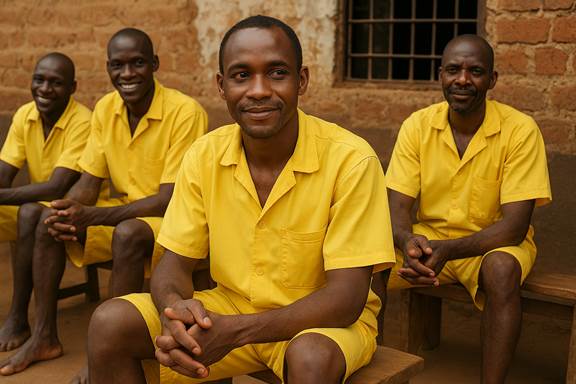
At Kitalya Mini-Max Prison in Wakiso, the focus on rehabilitation is quite evident. Inside spacious workshops, inmates work with sewing machines, carpentry tools, and computers instead of idling away in their cells. John, a 29-year-old inmate, reflects on his journey:
“I came in angry and hopeless. But learning tailoring changed everything. I’m saving money from the uniforms I sew. When I leave, I want to start a workshop in Masaka and employ others.”
Cultivating Change
In Gulu and Lira prisons in northern Uganda, rehabilitation is carried out through agriculture. Large fields of maize, beans, and vegetables are cultivated not only to feed inmates but also to support local food supplies. Rehabilitation-focused agricultural programmes have introduced improved seeds, modern farming techniques, and cooperative models for reintegration.
Peter, a former inmate turned farmer, says, “I learned to grow crops in Gulu Prison. Now I farm my own land and supply beans to schools. I no longer fear returning to crime because I have something meaningful to do.”
Empowering Through Skills
At Jinja Main Prison, inmates are developing a new identity through craftsmanship. Workshops equipped with modern tools train both men and women in carpentry, metal fabrication, and tailoring. Sarah (pseudonym), a 34-year-old inmate, proudly shows off a desk she has just built:
“This was my first time using a hammer. Now I can make school furniture. I feel like I have a future again.”
From Prison to Enterprise
In Fort Portal and Mbarara, the ripple effects of rehabilitation are evident beyond prison walls. Ex-inmates have established microbusinesses ranging from shoemaking to poultry farming. Michael (pseudonym), who was once imprisoned for robbery, now co-owns a leather workshop initiated by former inmates from Fort Portal Prison.
Prison provided me with skills, but the reintegration fund gave me the first step. We now make leather shoes for schools. My past no longer defines me.
A Model for Sustainable Reform
In Luzira and Kitalya prisons, inmates produce furniture, uniforms, and leather goods that supply government agencies, generating over UGX 2 billion annually for the Uganda Prisons Service. The profits are reinvested into expanding rehabilitation facilities and enhancing inmate welfare. The Austrian Development Cooperation, working through JLOS, has played a key role in upgrading these vocational workshops, supporting staff training, and funding prison health services. Plans are underway for a modern Luzira Prison Hospital, a project partially supported through international partnerships.
Partners in Progress
The progress Uganda benefits from today results from sustained investment and partnerships. Through JLOS, institutions such as the Austrian Development Cooperation, the European Union, and the UNODC have provided vital funding, technical assistance, and policy support. ADC, through budget support to JLOS, has supported the prisons’ rehabilitation agenda for over a decade, funding vocational workshops, reintegration programmes, and correctional officer training. Its emphasis on ‘human dignity and inclusive justice’ aligns perfectly with Uganda’s national priorities under JLOS.
A Model for Africa
Delegations from Kenya, Zambia, Sierra Leone, and South Sudan have visited Uganda to learn about its rehabilitation strategy. Through cooperation among JLOS institutions, the government, and partners such as ADC, Uganda has demonstrated that rehabilitation reduces crime, conserves public resources, and strengthens communities.
Justice That Restores
Uganda’s prisons tell a new story, one of hope, discipline, and redemption. From Gulu to Fort Portal, from Luzira to Arua, thousands of men and women are receiving a second chance at life. As Sarah from Jinja reflects: “They called it prison, but for me, it became a school for life.”
🤝 Development Partner Highlights
- Austria Development Cooperation (ADC): Long-term partner supporting vocational training, agriculture, and correctional health systems.
- European Union: Financing infrastructure improvements and prison modernisation.
- UNODC: Technical support for policy reform and staff training.
- Justice, Law and Order Sector (JLOS): Lead government coordination body driving justice reform.
This article was researched, developed, and published with support from the Austrian Development Cooperation (ADC) and the Embassy in Uganda, in partnership with the Justice, Law and Order Sub-programme (JLOS), Ministry of Justice and Constitutional Affairs.
© 2025 All rights reserved.