Uganda’s justice system is undergoing a quiet revolution—one that shifts from confrontation to conversation. Through Alternative Dispute Resolution (ADR), particularly mediation, the Judiciary and partner agencies within the Justice, Law, and Order Sub-programme (JLOS) are ensuring that justice is not only done but also done swiftly, fairly, and peacefully. Once hindered by backlogs and procedural delays, Uganda’s courts now turn to mediation as a quicker, more affordable, and more collaborative way to resolve disputes —from family disagreements to commercial conflicts.
📊 Key ADR Achievements
- 60% of civil and family cases resolved through mediation.
- Case backlog reduced by 40% in key divisions.
- Mediation integrated into all High Court circuits.
- Community mediation centres operational in over 30 districts.
- An e-ADR platform is under development for virtual mediation.
Turning Conflict into Consensus
Under the Judicature (Mediation) Rules 2013, mediation was integrated into court procedures. Every civil case must undergo mediation before trial. The results have been impressive, with 60% of cases settled without full hearings. Justice Sarah Langa Siu notes: “Mediation gives people closure in days rather than years.”
Stories of Resolution and Relief
Grace Nassanga, a market vendor in Masaka, resolved a land dispute with her brother in just two mediation sessions. “We agreed to share the land,” she says. “We even hugged after signing. I never thought the court could bring peace.” In Kampala, two business partners saved their company through commercial mediation. “Mediation reminded us that we were not enemies, just partners who disagreed,” recalls Ali Kimbugwe, an SME owner based in Kikuubo (a local business hub in the heart of Kampala).
A Ripple Effect on Case Backlogs
By resolving cases early, mediation has reduced the backlog by 40% in High Court divisions. Judges now concentrate on complex cases while routine disputes are settled amicably. Deputy Chief Justice, His Lordship Flavian Zeija (former Principal Judge) notes: “Every case resolved through dialogue saves public money and court time.”
Beyond Courts: Mediation at the Community Level
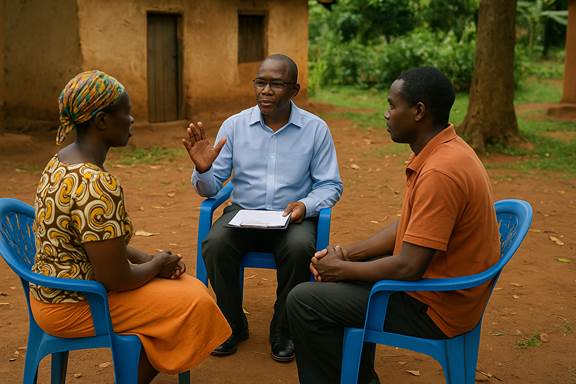
ADR extends beyond courts. Local Council Courts, Probation Offices, and Justice Centres Uganda (JCU) utilise community mediation. In Kiryandongo and Arua, mediators supported by UNDP and JLOS rapidly resolve domestic and property disputes. A mediator in Arua explains: “We sit people under a tree, let them speak, and guide them to an agreement.”
Partnerships and Innovation Driving ADR.
The Judiciary’s Mediation Programme has expanded through collaborations with JLOS, ADC, UNDP, EU, and IFC. Commercial mediation centres and training programmes are enhancing capacity, while the e-ADR platform will enable virtual sessions and online filings.
Building a Culture of Peaceful Justice.
Mediation is transforming how Ugandans view justice, shifting from punishment to problem-solving. As Justice Langa notes: “When parties agree, there are no losers — only solutions. That’s the true spirit of justice.”
Looking Ahead: Expanding ADR Nationwide.
Plans are in progress to expand Mediation Centres across all High Court circuits and to train judicial officers, lawyers, and community mediators. Public awareness campaigns are being intensified in rural areas where access to courts remains limited.
Justice that Heals.
Uganda’s adoption of mediation signifies a pivotal shift in justice delivery. It conserves time, resources, and relationships while rebuilding trust in the system. “Before, going to court meant fighting. Now, it means talking and understanding,” says Daniel Ankunda, a Kampala-based lawyer who has represented clients in mediation sessions. Through ADR, Uganda demonstrates that genuine justice focuses on resolution and reconciliation.
🤝 Partner Contributions
- ADC: Funded the ADR capacity building programmes
- JLOS: Coordinated ADR reforms nationwide.
- UNDP: Supported community mediation centres.
- EU: Funded awareness campaigns and training.
- IFC: Supported commercial mediation infrastructure.
- Judiciary: Institutionalised mediation through the Judicature Rules.
This article was researched, developed, and published with support from the Austria Development Cooperation (ADC) and Embassy in Uganda in partnership with the Justice, Law and Order Sub-programme (JLOS), Ministry of Justice and Constitutional Affairs.
© 2025 All rights reserved.