For decades, survivors of sexual and gender-based violence (SGBV) in Uganda faced a tough journey through the justice system, slow investigations, stigma, and emotional trauma that often silenced their voices. However, now a quiet revolution is transforming that story. Across the country, the Justice, Law, and Order Sub-programme (JLOS), with support from UNFPA and UN Women, is leading survivor-centred justice reforms that combine compassion, technology, and law to protect victims and ensure accountability for offenders.
📊 Key Achievements
- Over 15,000 SGBV cases have been fast-tracked through special court sessions since 2018.
- Conviction rates of up to 80% in SGBV-focused High Court sessions
- 12 One-Stop GBV Centres established
- 60% reduction in SGBV case backlog in JLOS institutions
- Over 300 judicial officers trained in gender-sensitive adjudication.
From Silence to Survivor-Centred Justice
Sexual and Gender-Based Violence (SGBV) remains one of Uganda’s most critical social issues, impacting women, children, and men across both urban and rural regions. According to national data, one in three Ugandan women experiences some form of gender-based violence during her lifetime. Despite this reality, Uganda has developed one of Africa’s most advanced responses, a system that focuses on healing, dignity, and prosecution. The key element of this reform is the One-Stop GBV Centres, established with support from JLOS and UNFPA. Here, survivors receive medical treatment, counselling, legal assistance, and police support all in one place. Centres in Gulu, Mbale, Mbarara, and Lira have become vital sources of support for thousands of people.
“When I arrived at the centre, I was not treated as a case file but as a person,” says Sarah (pseudonym), a survivor in Mbarara. “I received treatment, counselling, and my case was taken up on the same day.”
Special SGBV Sessions: Justice Without Delay
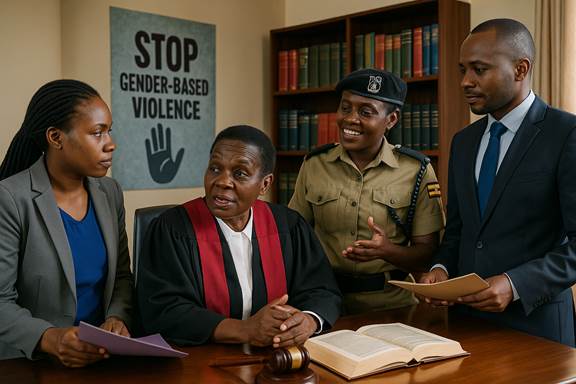
A significant advancement in Uganda’s judiciary is the introduction of specialised SGBV court sessions and expedited hearings designed to reduce case backlog and prevent survivor retraumatisation. Supported by UNFPA, these sessions focus on privacy and use trauma-sensitive language, and are led by trained judicial officers. Since 2018, more than 15,000 SGBV cases have been heard through these sessions across the High Court circuits in Kampala, Masaka, Soroti, and Arua, with conviction rates reaching 80%. One of the Chief Magistrates who supervises one such court, states:
“Our courts used to be intimidating spaces. Now, we operate with empathy. We ensure survivors feel safe enough to speak; that’s how justice begins.”
Technology and Forensic Innovation
With support from JLOS and its partners, Uganda has established modern DNA testing laboratories and mobile forensic evidence vans, enabling faster collection and analysis of evidence. Police officers are trained to handle digital and biological evidence carefully, strengthening prosecution and reducing acquittals. Digital reporting apps and toll-free hotlines allow survivors to report incidents privately, bridging the gap between communities and justice institutions.
Community-Level Interventions: Prevention Through Awareness
Beyond courts and laboratories, community-based initiatives are changing attitudes and stopping violence before it occurs. In partnership with probation officers, local councils, and civil society, JLOS institutions run dialogues, school campaigns, and radio programmes to challenge harmful gender norms. In Kitgum, youth-led clubs supported by UNFPA perform dramas that advocate for gender equality. In Bushenyi, religious leaders work with police gender desks to counsel couples and prevent domestic violence. “Before, people didn’t report. They thought it was a family matter. But now they know gender violence is a crime,” says a community leader in Lira.
The Role of JLOS Institutions
JLOS institutions, including the Judiciary, Police, Directorate of Public Prosecutions (DPP), Prisons Service, and Probation Departments, have played a vital role in aligning Uganda’s SGBV response. Under the National SGBV and Violence Against Children Action Plan, data collection and survivor protection have been strengthened, and services have been extended to refugee-hosting districts.
The Uganda Prisons Service now incorporates psychosocial rehabilitation for offenders. At the same time, the Child and Family Protection Units (CFPUs) in the Uganda Police Force offer frontline protection for women and children.
Partnerships That Drive Change
None of this progress would have been possible without Uganda’s enduring partnerships with UNFPA, UN Women, and other donors. UNFPA has supported One-Stop GBV Centres, forensic services, and awareness campaigns. UN Women has strengthened survivor-friendly court procedures and trained judicial officers in gender-responsive adjudication. JLOS integrates these initiatives into the broader justice reform agenda. According to a recent JLOS evaluation, these partnerships have reduced case turnaround time by over 60% and increased public confidence in justice institutions.
A Justice System That Heals
From courtroom reforms to hospital corridors, Uganda’s response to SGBV tells a story of resilience and reform. Survivors are no longer just statistics; they are reclaiming their dignity through a justice system designed to heal. “Justice gave me my voice back,” says Sarah (not real name) – an SGBV survivor from Mbarara. “And that has made all the difference.”
Through ongoing collaboration among JLOS, UNFPA, and UN Women, Uganda demonstrates that when justice listens, healing begins.
⚖️ Key Milestones
- 2018 – Launch of Special SGBV Sessions in High Court circuits
- 2019 – 50 judicial officers trained in gender-sensitive case handling
- 2020 – Forensic vans integrated into evidence systems
- 2022 – Virtual hearings for SGBV cases introduced
- 2024 – SGBV courts achieve 80% conviction rate
🤝 Partner Contributions
- UNFPA: Supported the establishment of One-Stop GBV Centres and mobile forensic labs.
- UN Women: Strengthened survivor-centred courts and judicial training.
- JLOS: Coordinated policy, funding, and integration of reforms
- Civil Society: Supported psychosocial care, awareness campaigns, and survivor reintegration.
💬 Voices of Resilience
“When I arrived at the centre, I was not treated as a case file but as a person.” — Sarah (pseudonym), SGBV Survivor, Mbarara.
“Our courts used to be intimidating spaces. Now, we operate with empathy.” — Chief Magistrate.
“Before, people didn’t report. Now they know gender violence is a crime.” —, Community Leader, Lira.
This article was researched, developed, and published with support from the Austrian Development Cooperation (ADC) and the Embassy in Uganda, in partnership with the Justice, Law, and Order Sub-programme (JLOS) of the Ministry of Justice and Constitutional Affairs.
© 2025 All rights reserved.