
Uganda will take part in the 15th United Nations Congress on Crime Prevention and Criminal Justice, which runs at the Abu Dhabi National Exhibition Centre from 25 September to 1 October 2026 under the theme “Accelerating crime prevention, criminal justice and the rule of law: protecting people and planet and achieving the 2030 Agenda for Sustainable Development in the digital age”. The Minister of Justice and Constitutional Affairs leads the delegation, with the Director of Public Prosecutions as alternate head.
What distinguishes the Ugandan delegation is its composition. It brings together the Uganda Police Force, the Office of the Director of Public Prosecutions, the Judiciary, the Uganda Prisons Service and the Ministry of Justice and Constitutional Affairs, alongside the Legal Aid Service Providers Network (LASPNET) and Uganda Youth Development Link (UYDEL). These are not delegates attending in parallel. Between them, they carry a criminal case from the first report to the last day of a sentence: a complete, working chain.
The Uganda Police Force investigates and secures evidence. The Office of the Director of Public Prosecutions decides what is charged and carries the case in court. The Judiciary tries it. The Prisons Service holds those on remand and those convicted, and runs the rehabilitation and reintegration work that determines whether they return. LASPNET member organisations provide legal aid to accused persons and complainants who could not otherwise afford representation, and UYDEL works upstream with young people in urban settlements where offending usually begins. A failure at any one point is felt at all the others.
Coordinating them is the point of the chain-link model. Uganda adopted a sector-wide approach to justice in 1999, beginning with ten institutions and now covering eighteen ministries, departments and agencies that plan, budget, implement and report together under the Justice, Law and Order Sub-programme (JLOS). This model allows Uganda to arrive in Abu Dhabi with one criminal justice position rather than several institutional ones.
Reforms Uganda Will Showcase
On crime prevention, Uganda’s Justice for Children programme has built child-friendly court processes and specialised handling of cases involving minors, and the response to gender based violence has moved towards specialised prosecution and better coordinated referral. Community policing structures extend into parishes and villages, and civil society largely delivers prevention work with young people.
On access to justice, the pressure has been volume and delay. Plea bargaining, court-annexed mediation, community service and expanded magistrate jurisdiction have been used to move cases and reduce the numbers held on remand. Alternative dispute resolution has been adopted deliberately as a model rooted in African practice rather than imported wholesale. Progress has been uneven across regions and court levels, and that unevenness is part of what Uganda intends to discuss rather than to leave out.
On new and evolving forms of crime, the work covers the modernisation of forensic services, the handling of digital evidence, anti-money laundering through the Financial Intelligence Authority, and inter-agency action against corruption led by the Inspectorate of Government.
On technology, the Electronic Court Case Management Information System (ECCMIS) now carries court business that once moved on paper, including the 2026 presidential election petition, which was filed electronically for the first time in Uganda’s jurisprudence. The unfinished task is integration, so that case data moves between the Police, prosecution, courts and prisons instead of being entered afresh at every stage.
Exhibition and side event
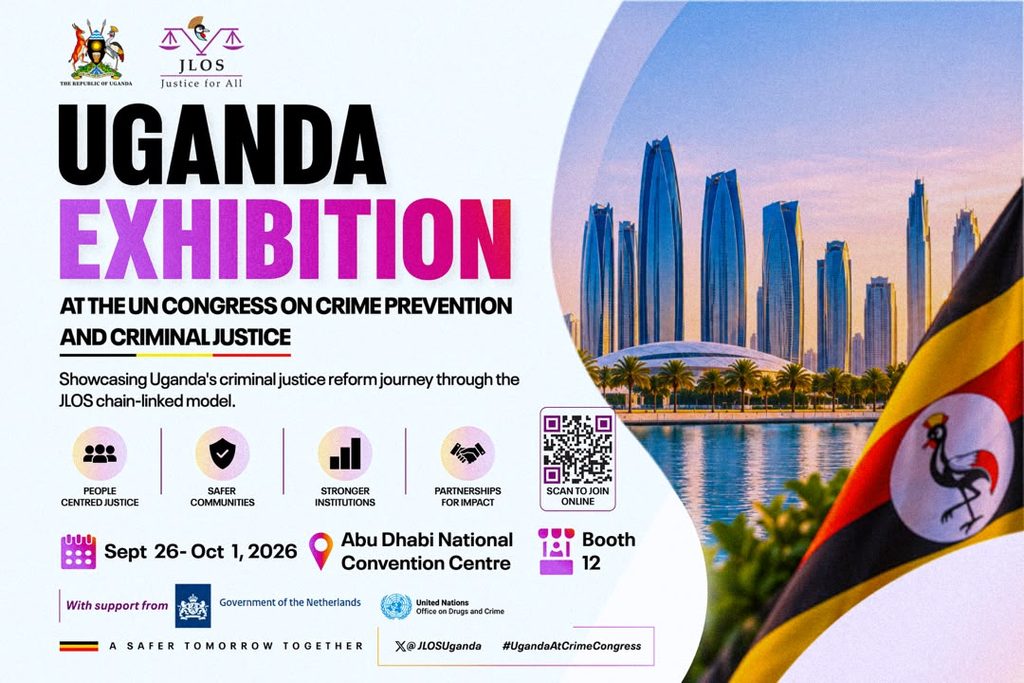
The Government of Uganda, through JLOS, will host a national exhibition booth for the duration of the UN Crime Congress, titled “Showcasing Uganda’s Criminal Justice Reform Journey through the JLOS Chain-Link Model“. The booth will feature demonstrations of digital justice platforms, documentary material, and a compendium of Uganda’s justice reforms.
On Monday, 28 September (10:30 am – 11:30 am), Uganda will hold a side event on its criminal justice and crime prevention reforms and how they have been delivered through partnership between Government and civil society, co-organised with LASPNET and UYDEL. The choice of co-organisers reflects how justice actually reaches people in Uganda, where legal aid, paralegal support and youth crime prevention are delivered largely by civil society working alongside state institutions.
Colleagues from other delegations and from the Programme Network Institutes are welcome at both. Uganda is also interested in what it can learn from the criminal justice global community on reoffending, prison congestion, digital evidence, and cross-border cooperation.
Prepared by the Governance and Security Programme (JLOS) Secretariat, Ministry of Justice and Constitutional Affairs, Uganda.